Mostrando entradas con la etiqueta matter. Mostrar todas las entradas

lunes, 21 de noviembre de 2016

BECOMING A SCIENTIST: EXPLAIN ME MATTER ( Natural Science Y6 )

FUNDAMENTACIÓN LEGISLATIVA DEL PROYECTO SEGÚN DECRETO 26/2016,  de 21 de junio, por la que se establece el currículo y se regula la implantación, evaluación y desarrollo de la educación primaria en la Comunidad de Castilla y León.


Curso 6º de EP, Área Ciencias de la Naturaleza, bloque 4 Matería y Energía. 

CONTENIDOS:


  • Predicción de alteraciones en el movimiento y en la forma de los cuerpos por efecto de las fuerzas y los cambios de estado.
  • Las mezclas y sus tipos. Separación de componentes de una mezcla mediante destilación, filtración, evaporación o disolución.
  • Reacciones químicas: la combustión, la oxidación y la fermentación.
CRITERIOS DE EVALUACIÓN:

2. Identificar los estados de la materia y los cambios de estado.
5. Realizar experiencias sencillas y pequeñas investigaciones sobre diferentes fenómenos físicos y químicos de la materias.

ESTÁNDARES EVALUABLES: 

2.1. Identifica, experimenta y ejemplifica algunos cambios de estado y su reversibilidad.
5.1. Realiza experiencias sencillas para separar los componentes de una mezcla mediante: destilación, filtración, evaporación o disolución, comunicando de forma oral y escrita el proceso seguido y el resultado obtenido.
5.2. Identifica y expone las principales características de las reacciones químicas: combustión, oxidación y fermentación.
5.3. Separa los componentes de una mezcla mediante destilación, filtración, evaporación o disolución.

COMPETENCIAS CLAVE:
  • Competencia en comunicación lingüística.
    • Al finalizar el proyecto el alumno será capaz de: 
      • Estructurar su conocimiento acerca de la materia y sus cambios.
      • Buscar, recopilar, procesar y comunicar la información acerca de la materia y sus cambios.
  • Competencia digital.
    • Al finalizar el proyecto el alumno será capaz de:
      • Comunicar la información y los contenidos relativos a la materia y sus diferentes cambios.
      • Generar producciones responsables y creativa.
      • Utilizar las TIC como instrumento de trabajo intelectual como generadoras y transmisoras de conocimiento.
  • Aprender a aprender. 
    • Al finalizar el proyecto el alumno será capaz de:
      • Autoevaluarse. 
      • Ser perseverante y responsable.
      • Valorar las posibilidades de mejora.
      • Reflexionar sobre su aprendizaje y el camino seguido a través de su diario de aprendizaje. 
      • Realizar observaciones directas sobre los contenidos adquiridos en las clases teóricas. 
  • Sentido de iniciativa y espíritu emprendedor. 
    • Al finalizar el proyecto el alumno será capaz de:
      • Trabajar en equipo con independencia del role que tenga, estableciendo objetivos a corto y medio plazo. 
  • Competencia matemática y competencias básicas en ciencia y tecnología. 
    • Al finalizar el proyecto el alumno será capaz de:
      • Poner en práctica procesos de razonamiento que le lleven a la resolución de problemas y obtención de información. 
      • Analizar los cambios físicos y químicos que puede sufrir la materia.

EXPLANATION OF THE ACTIVITY.

During the following weeks you will become a Scientist and you will prove all the things you have learnt during Natural Science lessons about matter.

Your aim will be:
  • Create a video or presentation (SWAY) in which you show everybody: states of matter, the changes of state in matter, pure substances and mixtures, methods of separating mixtures and matter changes. 
DAILY AIMS:

  1. Understand the ICT task and create the learning diary.
  2. Design the storyboard.
  3. Write the script.
  4. Record the videos.
  5. Make the video or presentation (SWAY).
  6. Write the post in kidblog and send it through Classroom.

In this presentation you will see what the process will be:


Here you have all the material you will need to support your ICT task:

A presentation to explain you how to work with Sway:

A video to explain you how to work with Windows Movie Maker:


lunes, 10 de febrero de 2014

BECOMING A SCIENTIST: EXPLAIN ME MATTER ( Unit 6 - Science Y5 )

OBJETIVOS DE LA ACTIVIDAD: (Siguiendo el Currículo para Educación Primaria de Castilla y León - Real Decreto 40/2007 de 3 de mayo)
Al final de la actividad el alumno será capaz de:

  • Realizar experiencias sencillas para estudiar las propiedades de los materiales de uso común. 
  • Expresar, mediante la realización de un vídeo, los diferentes estados de la materia y los posibles cambios que esta pueda sufrir.
  • Utilizar las TIC para la búsqueda de información y realización de su trabajo.
  • Reflexionar su propio aprendizaje y organización del trabajo utilizando técnicas de autocorrección y evaluación. 
ENFOQUE COMPETENCIAL:
  • Competencia lingüística:
El alumno será capaz:
    • Estructurar su conocimiento acerca de la materia y sus cambios.
    • Buscar, recopilar, procesar y comunicar la información acerca de la materia y sus cambios. 
  • Competencia matemática:
El alumno será capaz:
  • Poner en práctica procesos de razonamiento que le lleven a la resolución de problemas y obtención de información. 
  • Competencia de interación con el mundo físico y natural:
El alumno será capaz:
  • Analizar los cambios físicos y químicos que puede sufrir la materia.
  • Realizar observaciones directas sobre los contenidos adquiridos en las clases teóricas. 

  • Competencia Digital y tratamiento de la información:
El alumno será capaz:
  • Comunicar la información y los contenidos relativos a la materia y sus diferentes cambios.
  • Generar producciones responsables y creativa.
  • Utilizar las TIC como instrumento de trabajo intelectual como generadoras y transmisoras de conocimiento.
  • Competencia de autonomía e iniciativa personal:
El alumno será capaz:
  • Autoevaluarse. 
  • Ser perseverante y responsable.
  • Valorar las posibilidades de mejora.

EXPLANATION OF THE ACTIVITY.

During the following week you will become a Scientist and you will prove all the things you have learnt during Science lessons about matter.

Your aim will be:
  • Create a video in which you show everybody: states of matter, the changes in matter and the changes of state. 
In this presentation you will see what the process will be:


Here you have all the material you will need to support your work:

LINKS TO YOUR TEACHER'S BLOG ABOUT THIS TOPIC:
  • Matter.
  • Properties of matter.
  • Changes in matter.
  • Changes of state. 
A VIDEO TO EXPLAIN YOU HOW TO WORK WITH WINDOWS MOVIE MAKER:


viernes, 7 de febrero de 2014

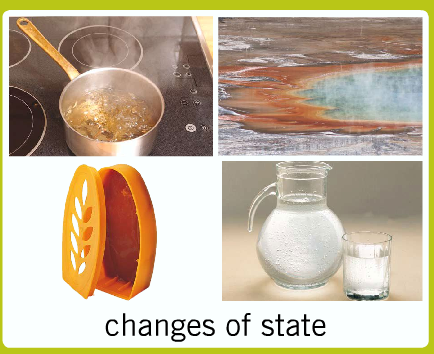
CHANGES OF STATE (Unit 6-Science Y5)

Today we are going to finish the topic of MATTER. Also we have learnt about PROPERTIES OF MATTER and CHANGES IN MATTER
Finally we are going to get to know the CHANGES OF STATE.


First we will watch this video, even though you have to answer these three questions on your notebook:
  • How many states of matter are there?
  • How many changes of state are there?
  • Can you explain to the rest of the class any change of state?
The video is on this web page:
Also we are going to make the test yourself in common.

STATES OF MATTER


SOLIDS LIQUIDS and GASES 


CHANGES OF STATE
This change of state sometimes occurs when the temperature changes.


To get to know more about changes in state we are going to visit this webpage:


A solid changes into a liquid.


A liquid changes into a liquid.


A liquid changes into a gas. (100º C)


A liquid changes into a gas.


A gas changes into a liquid.


A solid changes into a gas.

To refresh changes of state you should do this activity:


martes, 4 de febrero de 2014

CHANGES IN MATTER (Unit 6-Science Y5)

We are learning about MATTER, PROPERTIES OF MATTER and today we are getting to know CHANGES IN MATTER.

First we will watch this video, even though you have to answer these three questions on your notebook:
  • How many types of changes in matter are there?
  • Can you explain to the rest of the class what a physical change is?
  • Can you explain to the rest of the class what a chemical change is?
The video is on this web page:
Also we are going to make the test yourself in common.


CHANGES IN MATTER
There are two types:

 The object or substance changes, but the matter remains the same.

The original matter changes into a different substance.

To get to know more about Physical changes and Chemical changes we are going to visit this webpage:

Physical changes:


Chemical changes:


To refresh changes in matter you should do this activity:

martes, 28 de enero de 2014

MATTER (Unit 6 - Science Y5)

Today we are going to start a new unit MATTER.

First to get to know more about Matter we are going to watch this video:

Where can we find matter in the universe?
Everywhere because everything is made of matter.

What are tiny particles called that matter is made of?
Atoms

Then, we are going to visit this webpage:

MatterMatter


An element is matter which consists of only one type of atom.
A compound is matter which consists of more than one kind of atom.

TYPES OF MATTER

 Are made up of a single type  of element or compound.

 Are made up of several pure substances.
PROPERTIES OF MATTER

General properties: All matter has general properties like mass and volume.


Characteristic properties: Properties like odour, colour, shininness and density are characteristic.


domingo, 17 de marzo de 2013

VIDEOS ABOUT MATTER (Science Y5)

Tengo el placer de presentaros los post publicados por los alumnos de 5ºB en la asignatura de Science.

Estos posts han sido publicados en el blog de aula:

Los alumnos han utilizado la herramienta de la web 2.0 POPPLET para hacer sus propios diagramas o mapas conceptuales sobre la unidad 6 MATTER. 

Después han utilizado sus propios mapas conceptuales para construir un vídeo utilizando la web tool http://www.screencast-o-matic.com/

Ese vídeo es "upload" por ellos mismos a su propio canal de youtube para terminar con todo ello, en su propio blog, construyendo un post dedicado a resumir y entender mejor la unidad.

Aquí os dejo con cada post hecho por cada alumno.

    martes, 19 de febrero de 2013

    CHANGES OF STATE (Unit 6-Science Y5)

    Today we are going to finish the topic of MATTER. Also we have learnt about PROPERTIES OF MATTER and CHANGES IN MATTER
    Finally we are going to get to know the CHANGES OF STATE.


    First we will watch this video, even though you have to answer these three questions on your notebook:
    • How many states of matter are there?
    • How many changes of state are there?
    • Can you explain to the rest of the class any change of state?
    The video is on this web page:
    Also we are going to make the test yourself in common.

    STATES OF MATTER


    SOLIDS LIQUIDS and GASES 


    CHANGES OF STATE
    This change of state sometimes occurs when the temperature changes.


    To get to know more about changes in state we are going to visit this webpage:


    A solid changes into a liquid.


    A liquid changes into a liquid.


    A liquid changes into a gas. (100º C)


    A liquid changes into a gas.


    A gas changes into a liquid.


    A solid changes into a gas.

    To refresh changes of state you should do this activity:


    jueves, 7 de febrero de 2013

    CHANGES IN MATTER (Unit 6-Science Y5)

    We are learning about MATTER, PROPERTIES OF MATTER and today we are getting to know CHANGES IN MATTER.

    First we will watch this video, even though you have to answer these three questions on your notebook:
    • How many types of changes in matter are there?
    • Can you explain to the rest of the class what a physical change is?
    • Can you explain to the rest of the class what a chemical change is?
    The video is on this web page:
    Also we are going to make the test yourself in common.


    CHANGES IN MATTER
    There are two types:

     The object or substance changes, but the matter remains the same.

    The original matter changes into a different substance.

    To get to know more about Physical changes and Chemical changes we are going to visit this webpage:

    Physical changes:


    Chemical changes:


    To refresh Changes in matter you shoul do this activity:

    miércoles, 30 de enero de 2013

    MATTER (Unit 6-Science Y5)

    Today we are going to start a new unit MATTER.

    First to get to know more about Matter we are going to watch this video:

    Where can we find matter in the universe?
    Everywhere because everything is made of matter

    What are tiny particles called that matter is made of?
    Atoms

    Then, we are going to visit this webpage:

    MatterMatter


    An element is matter which consists of only one type of atom.
    A compound is matter which consists of more than one kind of atom.

    TYPES OF MATTER

     Are made up of a single type  of element or compound.

     Are made up of several pure substances.
    PROPERTIES OF MATTER

    General properties: All matter has general properties like mass and volume.


    Characteristic properties: Properties like odour, colour, shininness and density are characteristic.