Mostrando entradas con la etiqueta moon. Mostrar todas las entradas

miércoles, 5 de febrero de 2014

THE MOON and ECLIPSES (Unit 7- Science Y6)

Do you know that the Moon orbits the Earth and rotates on its axis?

This video may explain you lots of characteristics of the MOON and ECLIPSES. 


The moon has four LUNAR PHASES, they depend on the Moon's position in relation to both the Earth and the Sun.

  • NEW MOON: no part of the moon is visible.
  • FIRST QUARTER: The illuminated half is increasing.

  • FULL MOON: The side of the moon facing the Earth is being lit by the Sun.

  • LAST QUARTER: The illuminated half is decreasing.


Sometimes there is a great phenomenon, when the MOON, the SUN and the EARTH ALING. This is which we called ECLIPSE.

We can have two kinds of eclipse:
  • LUNAR ECLIPSE: The Earth passes between the Sun and the Moon and blocks the Sun's light.

  • SOLAR ECLIPSE: The Moon passes between the Earth and the Sun, block the Sun's light and project a shadow on the Earth. If they are in a perfect line it is a TOTAL ECLIPSE. 
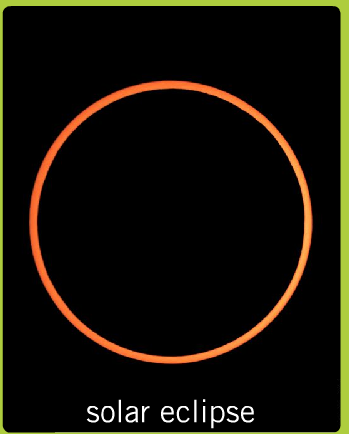
To review the MOON we are going to watch this animation:
http://e-learningforkids.org/Courses/EN/S0801/login.htm

In the following link you can watch a short video about a Solar Eclipse. 


LET'S CHECK ALL YOUR LEARNING WITH THE FOLLOWING ACTIVITY:

viernes, 18 de enero de 2013

THE SOLAR SYSTEM´S PERFORMANCE (Unit 7-Science Y6)

This unit you have been learning about THE SOLAR SYSTEM, THE EARTH, THE MOON and ECLIPSES and finally STARS, CONSTELLATIONS and GALAXIES.

As a final task and project of this unit we are going to invite you to create a lesson about what you have learnt. We want you to be as much original as you can. 

Here you have some guidelines to help you to work:

  • You are going to do this final task with your class group.
  • The explanation will include the four parts of the unit:
    • The Solar System (planets and the sun)
    • The Earth (rotation and revolution)
    • The Moon (lunar phases) and Eclipses
    • Stars, constellations and galaxies. 
  • You have TO DO YOUR BEST: 
    • A performance.
    • A model.
    • Record a video and show it.
    • Create a song.
    • ....
    • The main objective is TO BE ORIGINAL. 
  • You will have four lessons to do it.
  • The final task will be shown to the rest of the class group along the last week of January (From the 28th to the 1st of February).

The presentation of the activity and the performance will have a SCRIPT, which you should show to the teacher before acting:
  • START: Group´s presentation and activity´s presentation.
  • NUB: Explain the activity. Each member of the group has got a role in the performance. (Explain with your own words)
  • ENDING: Activity´s conclusion and farewell.
Also you have to do a STORY BOARD, remember the example:

To evaluate your project we will use the following rubric. 
 
Rúbrica para evaluar la EXPRESIÓN ORAL


DO YOUR BEST!!!


miércoles, 16 de enero de 2013

THE MOON and ECLIPSES (Unit 7-Science Y6)

Do you know that the Moon orbits the Earth and rotates on its axis?

This video may explain you lots of characteristics of the MOON and ECLIPSES. 


The moon has four LUNAR PHASES, they depend on the Moon's position in relation to both the Earth and the Sun.

  • NEW MOON: no part of the moon is visible.
  • FIRST QUARTER: The illuminated half is increasing.

  • FULL MOON: The side of the moon facing the Earth is being lit by the Sun.

  • LAST QUARTER: The illuminated half is decreasing.


Sometimes there is a great phenomenon, when the MOON, the SUN and the EARTH ALING. This is which we called ECLIPSE.

We can have two kinds of eclipse:
  • LUNAR ECLIPSE: The Earth passes between the Sun and the Moon and blocks the Sun's light.

  • SOLAR ECLIPSE: The Moon passes between the Earth and the Sun, block the Sun's light and project a shadow on the Earth. If they are in a perfect line it is a TOTAL ECLIPSE. 

To know review the MOON we are going to watch this animation:
http://e-learningforkids.org/Courses/EN/S0801/login.htm

In the following link you can watch a short video about a Solar Eclipse. 


LET'S CHECK ALL YOUR LEARNING WITH THE FOLLOWING ACTIVITY: