jueves, 3 de abril de 2014

ACTIVITIES TO REVIEW THE UNIT 4 FOCUS ON FOOD

To review unit 4 Focus on Food, Y6 will do these exercises.

First of all, we will play MEMORY with our food cards

Remember the rules and the question `How do you spell that?´

To review COUNTABLE AND UNCOUNTABLE NOUNS, we will use this webpage: 

SOME / ANY / AN or A.  
To review MUST / MUSTN'T, we will use this webpage:

MUST or MUSTN´T. 

To remember the last unit WH-questions in past simple, we will use these webpages:

 PAST SIMPLE TENSE- WH questions
Past simple questions 1
Simple Past: Wh- Questions

 Enjoy and review the unit.

viernes, 28 de marzo de 2014

THE EUROPEAN UNION (Unit 10-Science Y6)

We have been learning about Europe as one of the five continents. In this lesson we are going to talk about EUROPEAN UNION which is a confederation fo countries. It is said, a group of some countries of Europe united for a common purpose.


THIS  VIDEO MAY CLARIFY YOUR IDEA ABOUT EUROPEAN UNION.

The EU's commo purpose is to promote political and economic union without frontiers.

The first members  were France, Italy, Germany, Holland, Belgium and Luxemborg. Today there are 27 countries and more than 490 millions of citizens.

FACTS:

  • The euro is the oficial currency in most of the countries, for example England hasn't got it, they have the pound. 
  • The citizens can live and work in any other member state.
  • The EU is developing its own defence and justice systems.


INSTITUTIONS:
  • Most of the institutions are based in Brussels (Belgium), Strasbourg (France) and Luxembourg.
  • The main institutions are:
      • The Council of Eurpoean Union.
      • The European Parliament
      • The European Commision
      • The Court of Justice.


LET'S PLAY AND LEARN MORE ABOUT EUROPEAN UNION IN THE FOLLOWING WEBSITE.


miércoles, 26 de marzo de 2014

POPULATION and DIVERSITY of EUROPE (Unit 10-Science Y6)

There are forty - eight independent nations in Europe.


PEOPLE AND DIVERSITY.

  • Europe  is home to many different inmigrants from Latin America, India, Africa and other places.
  • There is a great diversity of origins, religious beliefs, cultural traditions and languages.

Between thirty and forty major languages are spoken in Europe. How many languages can you list?

Play and review the topic with this activity:


To finish the lesson we are going to play SETERRA.
Furthermore, you could download it free here: http://www.seterra.net/es/descargue-seterra/

lunes, 24 de marzo de 2014

The coast (Unit 8 - Science Y5)

We have learnt about the landscape in general and about the mountains and plains in Spain. Now it's time to focus our attention in the coas landscape. We will introduce this topic with the following chant. (Let's sing if you want). 


THE COAST:

The coast is the place where the land meets the sea.

There are two types of coast:

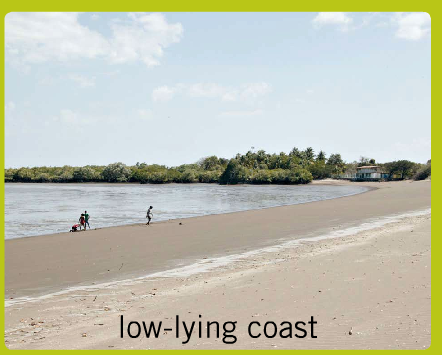
LOW-LYING COASTS: They are plains by the sea. They have sandy beaches. 

HIGH COASTS: They are high areas by the sea. They often have rocky cliffs.


LET'S THINK A MOMENT AND ANSWER THESE QUESTIONS:
  • Where can you see a high coast in Spain?
  • Where can you see a low-lying coast in Spain?


TYPES OF COASTLINES:


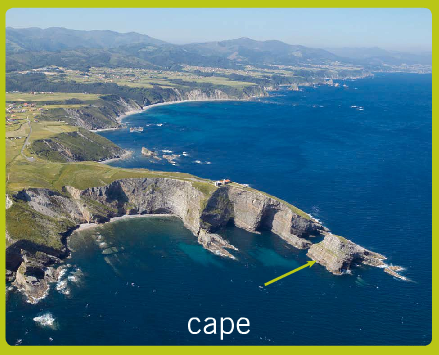
A CAPE: It is land which extends into the sea.

A GULF: It is a place where the sea extends into the land.


A PENINSULA: It is land which is almost completely surrounded by water.
AN ISLAND: It is land which is completely surrounded by water.

AN ARCHIPELAGO: It is a group of islands.

AN ESTUARY: It is a part of a river which opens into the sea.

A MARSH:  It is wet land near the mouth of a river. 


LET'S PLAY TO FIX YOUR KNOWLEDGE

viernes, 21 de marzo de 2014

MOUNTAINS and PLAINS in SPAIN (Unit 8-Science Y5)


We are going to start with a THINKING ROUTINE: THINK-PAIR-SHARE. 


  • THINK: During 1 minute you will think on your own about what you have learnt about Landscapes
  • PAIR: During 2 minutes you will talk with your partner about what you have thought. REMEMBER YOU HAVE TO TALK IN ENGLISH AND ALSO YOUR PARTNER, IF NOT YOU CAN SAY HIM OR HER. STOP! TALK TO ME IN ENGLISH.
  • SHARE: You will say to the whole class what you have thought or rememebered about the Landscapes. With your ideas the teacher will create a mind map in the blackboard. You can use this mind map to add all the new information you will learn today. 
In this video you will have a look about the highest mountains in Spain:
  • HAVE YOU EVER VISITED ANYONE OF THEM?
  • I HAVE VISITED...........................................

MOUNTAINS AND PLAINS IN SPAIN


  • Central Spain is dominated by a large plateau: CENTRAL PLATEAU. 
  • CENTRAL PLATEAU is divided into two parts by CENTRAL MOUNTAIN CHAIN.
  • THE PYRENEES is in the north it is the natural border with France.
  • THE BETIC CHAIN  is a chain in the south of the Central Plateau
  • Iberian Península has narrow coastal plains.
  • There are two depressions:
    • The Ebro Drepression in the north.
    • The Guadalquivir depression in the south. 

LET'S PLAY A BIT TO FIX ALL WHAT YOU HAVE LEARNT.