Mostrando entradas con la etiqueta solar system. Mostrar todas las entradas

miércoles, 12 de noviembre de 2014

EVALUATION ABOUT PARTNERS' THE SOLAR SYSTEM VIDEOS (Unit 1-Science Y6)

With this post we will keep on evaluating your partner's videos and mind maps following the rubric and answering to this form.


When you finish reading the rubric and you have everything clear about your mind, you can start watching your partner's video and answering the questions to evaluate it. 
IT IS VERY IMPORTANT TO HAVE CLEAR WHAT YOU HAVE TO LOOK FOR AND WHAT THE CRITERIAS FOR EVALUATION ARE.


You will send your evaluation through this Google Form. 
DON'T FORGET TO CLICK ON SUBMIT AT THE END.
To write the comments, you have to follow this pattern:
  • REDACCIÓN EN KIDBLOG: Tienes … puntos, porque…
  • ORGANIZACIÓN EN EL MIND MAP: Tienes … puntos, porque…
  • ESTRUCTURA DEL TEXTO: Tienes … puntos, porque…
  • ORTOGRAFÍA: Tienes … puntos, porque…
  • TÉCNICA GRAMATICAL Y TIEMPOS VERBALES: Tienes …puntos, porque…
  • VOZ Y RITMO: Tienes …puntos, porque...

VIDEOS ABOUT THE SOLAR SYSTEM (Unit 3 - Science Y6)

Tengo el placer de presentaros los post publicados por los alumnos de 6ºA en la asignatura de Science.


Estos posts han sido publicados en el blog de aula:


Los alumnos han utilizado la herramienta de la web 2.0 http://popplet.com/ para hacer sus propios diagramas o mapas conceptuales sobre la unidad 3 The Solar System. 

Después han utilizado sus propios mapas conceptuales para construir un vídeo utilizando la web tool http://www.screencast-o-matic.com/. Ese vídeo es "upload" por ellos mismos a su propio canal de youtube para terminar con todo ello, en su propio blog, construyendo un post dedicado a resumir y entender mejor la unidad.

Más tarde lo han enviado a una asignación por EDMODO nuestra red social.

Aquí, os dejo con cada post hecho por cada alumno.


miércoles, 5 de febrero de 2014

STARS, CONSTELLATIONS and GALAXIES (Unit 7- Science Y6)

How wonderful is to watch the stars in a warm summer night? How much do you know about the STARS?

This video will help yo to understand how to see the stars and also is going to show you some of them.


STAR: It is a spherical body which generates light and heat through nuclear reactions. Most stars consist of hydrogen and helium.
Stars have different characteristics:

  1. Colour.
  2. Size.
  3. Luminosity.

CONSTELLATIONS: They are groups of stars. There are eighty-eight constellations. They used to have the names of characters from mythology or the names of animals or objects because of the shape they form.


NEBULAE: A nebulae is a cloud of dust and gas. Some are illuminated by stars near them.
GALAXIES: Galaxies are enormous groups of stars, gases and dust.
There are three types:
  • Elliptical

  • Spiral.

  • Irregular. 

Our Solar System is inside a Galaxy called THE MILKY WAY.


If you want further information you can look in the following link.

LET'S CHECK YOUR LEARNING WITH THE FOLLOWING TEST AND ACTIVITIES.

THE MOON and ECLIPSES (Unit 7- Science Y6)

Do you know that the Moon orbits the Earth and rotates on its axis?

This video may explain you lots of characteristics of the MOON and ECLIPSES. 


The moon has four LUNAR PHASES, they depend on the Moon's position in relation to both the Earth and the Sun.

  • NEW MOON: no part of the moon is visible.
  • FIRST QUARTER: The illuminated half is increasing.

  • FULL MOON: The side of the moon facing the Earth is being lit by the Sun.

  • LAST QUARTER: The illuminated half is decreasing.


Sometimes there is a great phenomenon, when the MOON, the SUN and the EARTH ALING. This is which we called ECLIPSE.

We can have two kinds of eclipse:
  • LUNAR ECLIPSE: The Earth passes between the Sun and the Moon and blocks the Sun's light.

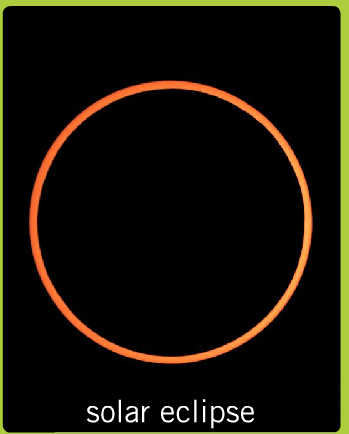
  • SOLAR ECLIPSE: The Moon passes between the Earth and the Sun, block the Sun's light and project a shadow on the Earth. If they are in a perfect line it is a TOTAL ECLIPSE. 

To review the MOON we are going to watch this animation:
http://e-learningforkids.org/Courses/EN/S0801/login.htm

In the following link you can watch a short video about a Solar Eclipse. 


LET'S CHECK ALL YOUR LEARNING WITH THE FOLLOWING ACTIVITY:

miércoles, 29 de enero de 2014

THE EARTH (Unit 7-Science Y6)

As we have learn the Earth in the last lesson the Earth is the third planet of the SOLAR SYSTEM. Like the song said to us it has got land and sea, this is why it seems to be blue.

THE EARTH


The earth has two kind of movements:
REVOLUTION
ROTATION


This video may clarify the two concepts for you:


REVOLUTION: It is the movement of the earth around the Sun. It takes 365 days and 6 hours. This is why we have LEAP YEARS every four years. The orbit around the sun it isn't a circle, IT IS AN ELLIPSE.


ROTATION: The earth has an invisible axis, and the earth rotates on it. It takes 24 hours. At any time there is half part facing the sun and half part facing away the sun. THIS IS WHY WE HAVE DAY AND NIGHT, and this is why the sun rises in the east and sets in the west. 


SEASONS: We have different seasons depending on what part of the orbit around the sun the Earth is. It is hotter when the Earth is nearer the Sun, and it is colder when it is further from the Sun. We also have different season depending on the hemisphere because of the slighty tilted axis. 


The best thing for learning something is doing it. SO LET MAKE A SHORT PLAY TO EXPLAIN THE ROTATION AND REVOLUTION OF THE EARTH.

YOU WILL NEED:
  1. A torch.
  2. Some  labels: The Moon, The Earth, The Sun, etc..
  3. The script.
  4. Some IMAGINATION.
In your group you are going to create a short play to explain the rest of the class how the Earth rotates and revolves around the Sun, also you should explain why do we have seasons and day and night. 

LET'S CHECK ALL YOUR LEARNING WITH THIS LINK  (You can show how the Earth moves and also do the quizz)


martes, 28 de enero de 2014

SOLAR SYSTEM (Unit 7-Science Y6)

It's time for THE SOLAR SYSTEM and the PLANETS.

Let's start with this new topic in a funny with a song which is going to explain to you the characteristics of each one of the eight planets of the Solar System.


The Solar System consists on the Sun, eight planets and their moons, comets and asteroids.


The SUN is the largest celestial body.


The PLANETS are eight large celestial bodies.
 They can be classified into two groups: 
terrestial and gas giants.

If you want further information about each planet you can follow the link:

Let's check you knowledge labelling this Diagram:

In the Solar System you can also find: 
ASTEROIDS

COMETS


With the following quiz you can check the knowlegde you have achive during the lesson.


lunes, 11 de febrero de 2013

THE SOLAR SYSTEM'S PERFORMANCE III (Unit 7-ScienceY6)


Tengo el placer de presentaros los post publicados por los alumnos de 6ºB en la asignatura de Science. En este caso de la unidad 7 "The Solar System"

Estos son los resultados de las siguientes actividades: 

THE SOLAR SYSTEM'S PERFORMANCE I

y

Estos posts han sido publicados en el blog de aula:

Los alumnos han utilizado creado su propio post para exponer el resultado final de esta tarea. 

Han utilizado los vídeos subidos en el canal de youtube Miprimeryearedxxi sobre sus actucaciones para construir un post 

Más tarde lo han enviado a una asignación por EDMODO nuestra red social.

Aquí os dejo con cada post hecho por cada alumno.


jueves, 31 de enero de 2013

THE SOLAR SYSTEM´S PERFORMANCE II (Unit 7-ScienceY6)

This time we have done a different activity as a final task of the Science Unit about the Solar System. In this post we explain to you how to do it.


This are the final products the students have created and perfomed in the Science Lesson. 


viernes, 18 de enero de 2013

THE SOLAR SYSTEM´S PERFORMANCE (Unit 7-Science Y6)

This unit you have been learning about THE SOLAR SYSTEM, THE EARTH, THE MOON and ECLIPSES and finally STARS, CONSTELLATIONS and GALAXIES.

As a final task and project of this unit we are going to invite you to create a lesson about what you have learnt. We want you to be as much original as you can. 

Here you have some guidelines to help you to work:

  • You are going to do this final task with your class group.
  • The explanation will include the four parts of the unit:
    • The Solar System (planets and the sun)
    • The Earth (rotation and revolution)
    • The Moon (lunar phases) and Eclipses
    • Stars, constellations and galaxies. 
  • You have TO DO YOUR BEST: 
    • A performance.
    • A model.
    • Record a video and show it.
    • Create a song.
    • ....
    • The main objective is TO BE ORIGINAL. 
  • You will have four lessons to do it.
  • The final task will be shown to the rest of the class group along the last week of January (From the 28th to the 1st of February).

The presentation of the activity and the performance will have a SCRIPT, which you should show to the teacher before acting:
  • START: Group´s presentation and activity´s presentation.
  • NUB: Explain the activity. Each member of the group has got a role in the performance. (Explain with your own words)
  • ENDING: Activity´s conclusion and farewell.
Also you have to do a STORY BOARD, remember the example:

To evaluate your project we will use the following rubric. 
 
Rúbrica para evaluar la EXPRESIÓN ORAL


DO YOUR BEST!!!


jueves, 17 de enero de 2013

STARS, CONSTELLATIONS and GALAXIES (Unit 7-Science Y6)

How wonderful is to watch the stars in a warm summer night? How much do you know about the STARS?

This video will help yo to understand how to see the stars and also is going to show you some of them.


STAR: It is a spherical body which generates light and heat through nuclear reactions. Most stars consist of hydrogen and helium.
Stars have different characteristics:

  1. Colour.
  2. Size.
  3. Luminosity.

CONSTELLATIONS: They are groups of stars. There are eighty-eight constellations. They used to have the names of characters from mythology or the names of animals or objects because of the shape they form.


NEBULAE: A nebulae is a cloud of dust and gas. Some are illuminated by stars near them.
GALAXIES: Galaxies are enormous groups of stars, gases and dust.
There are three types:
  • Elliptical

  • Spiral.

  • Irregular. 

Our Solar System is inside a Galaxy called THE MILKY WAY.


If you want further information you can look in the following link.

LET'S CHECK YOUR LEARNING WITH THE FOLLOWING TEST AND ACTIVITIES.

miércoles, 16 de enero de 2013

THE MOON and ECLIPSES (Unit 7-Science Y6)

Do you know that the Moon orbits the Earth and rotates on its axis?

This video may explain you lots of characteristics of the MOON and ECLIPSES. 


The moon has four LUNAR PHASES, they depend on the Moon's position in relation to both the Earth and the Sun.

  • NEW MOON: no part of the moon is visible.
  • FIRST QUARTER: The illuminated half is increasing.

  • FULL MOON: The side of the moon facing the Earth is being lit by the Sun.

  • LAST QUARTER: The illuminated half is decreasing.


Sometimes there is a great phenomenon, when the MOON, the SUN and the EARTH ALING. This is which we called ECLIPSE.

We can have two kinds of eclipse:
  • LUNAR ECLIPSE: The Earth passes between the Sun and the Moon and blocks the Sun's light.

  • SOLAR ECLIPSE: The Moon passes between the Earth and the Sun, block the Sun's light and project a shadow on the Earth. If they are in a perfect line it is a TOTAL ECLIPSE. 

To know review the MOON we are going to watch this animation:
http://e-learningforkids.org/Courses/EN/S0801/login.htm

In the following link you can watch a short video about a Solar Eclipse. 


LET'S CHECK ALL YOUR LEARNING WITH THE FOLLOWING ACTIVITY:

jueves, 10 de enero de 2013

THE EARTH (Unit 7-Science Y6)

As we have learn the Earth in the last lesson the Earth is the third planet of the SOLAR SYSTEM. Like the song said to us it has got land and sea, this is why it seems to be blue.

THE EARTH


The earth has two kind of movements:
REVOLUTION
ROTATION


This video may clarify the two concepts for you:


REVOLUTION: It is the movement of the earth around the Sun. It takes 365 days and 6 hours. This is why we have LEAP YEARS every four years. The orbit around the sun it isn't a circle, IT IS AN ELLIPSE.


ROTATION: The earth has an invisible axis, and the earth rotates on it. It takes 24 hours. At any time there is half part facing the sun and half part facing away the sun. THIS IS WHY WE HAVE DAY AND NIGHT, and this is why the sun rises in the east and sets in the west. 


SEASONS: We have different seasons depending on what part of the orbit around the sun the Earth is. It is hotter when the Earth is nearer the Sun, and it is colder when it is further from the Sun. We also have different season depending on the hemisphere because of the slighty tilted axis. 


The best thing for learning something is doing it. SO LET MAKE A SHORT PLAY TO EXPLAIN THE ROTATION AND REVOLUTION OF THE EARTH.

YOU WILL NEED:
  1. A torch.
  2. Some  labels: The Moon, The Earth, The Sun, etc..
  3. The script.
  4. Some IMAGINATION.
In your group you are going to create a short play to explain the rest of the class how the Earth rotates and revolves around the Sun, also you should explain why do we have seasons and day and night. 

LET'S CHECK ALL YOUR LEARNING WITH THIS LINK  (You can show how the Earth moves and also do the quizz)


miércoles, 9 de enero de 2013

SOLAR SYSTEM (Unit 7-Science Y6)

After Christmas break it is time to return to school and start with new topics in our Science lessons. Now it's time for THE SOLAR SYSTEM and the PLANETS.

Let's start with this new topic in a funny with a song which is going to explain to you the characteristics of each one of the eight planets of the Solar System.


The Solar System consists on the Sun, eight planets and their moons, comets and asteroids.


The SUN is the largest celestial body


The PLANETS are eight large celestial bodies.
 They can be classified into two groups: 
terrestial and gas giants.

If you want further information about each planet you can follow the link:

Let's check you knowledge labelling this Diagram:

In the Solar System you can also find: 
ASTEROIDS

COMETS


With the following quiz you can check the knowlegde you have achive during the lesson.